 Hiker
Ice Age Clues on New York Hikes: Scratches, Boulders & Lakes
An old mountain can carry younger marks. Glacial clues concern how a landscape was modified, not necessarily how its bedrock first formed.
By HikerQuests · Published · 2 min reading
The download is a self-contained HTML file with text, sources and any diagrams. Save and test opening it before leaving reception; outside links need a connection.

Moving ice can scratch bedrock
The National Park Service explains that rock debris embedded in moving ice can abrade the surface below it, leaving striations and polish. Groups of scratches can help researchers reconstruct ice movement. An isolated line on a rock is not enough for a confident identification; cracks, wear and human marks also need consideration. Sources: [1]
Some stones traveled from elsewhere
A glacial erratic is a rock transported by ice from its source. Comparing its rock type with nearby bedrock can help reveal that journey. Size alone is not the test: a large block below a cliff may instead be fallen local rock. Sources: [2]
New York field evidence has local detail
Epstein’s Shawangunk field guide distinguishes angular local blocks from rounded stones of varied rock types and discusses glacial deposits. That kind of field context matters more than attaching an Ice Age label to every interesting boulder you encounter. Sources: [3]
The Catskills’ ice history is still being refined
A 2026 study of glacial Lake Grand Gorge in the northern Catskills reports that the ice-dammed lake existed by about 28,000 years ago and likely persisted to at least about 22,000 years ago. The researchers used sediments and multiple dating methods. Their results show why one simple date for “when the glacier left the Catskills” can conceal a much more complicated local history. Sources: [4]
Keep the two clocks separate
Devonian bedrock ages are measured in hundreds of millions of years; the lake study concerns tens of thousands. Our schematic places ice over pre-existing rock to make the order clear. It does not show the exact thickness, direction or date of ice at a particular trailhead.
Turn a possible clue into a useful note
Record what you observed from the open trail, photograph it without altering it, and use a field guide to investigate later. “Possible glacial scratches” is a useful starting point when evidence is incomplete. It is better than presenting a guess as a verified geological feature.
Follow the process.
Three simplified stages. The sequence is conceptual; the drawings are not to scale and do not specify a trail’s exact geology.
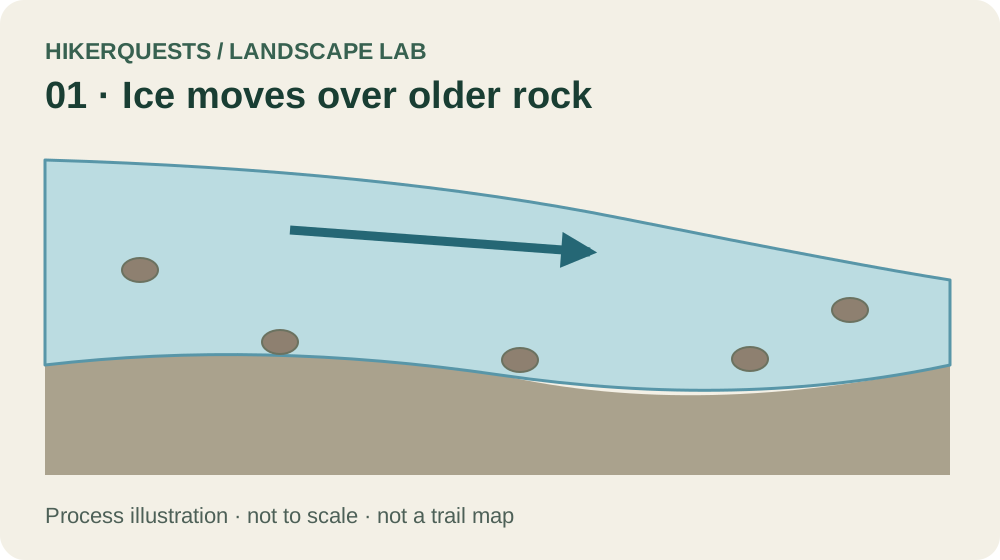
Ice moves over older rock
Much younger than the bedrock
Debris travels within moving ice over a pre-existing landscape. The arrow illustrates motion, not a measured local compass direction. Sources: [1], [2]
Download this original diagram (SVG) ↓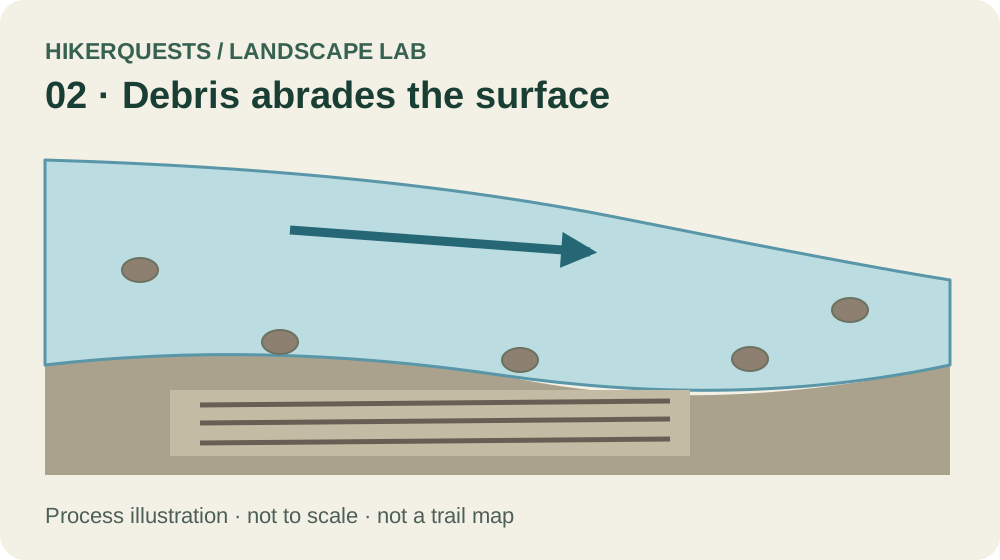
Debris abrades the surface
At the glacier bed
Rock fragments beneath moving ice can scratch and polish bedrock. The drawing exaggerates the marks so the mechanism is visible. Sources: [1]
Download this original diagram (SVG) ↓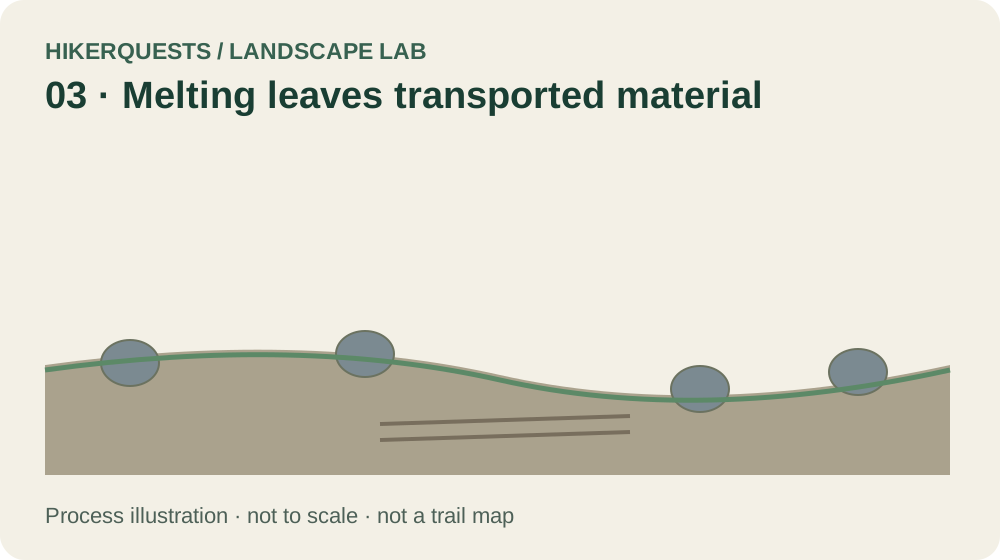
Melting leaves transported material
An exposed landscape
Ice-transported rocks remain after melting. Field context is needed to distinguish an erratic from a local fallen block. Sources: [2]
Download this original diagram (SVG) ↓Sources & reading notes
Checked October 3, 2026. Links lead to original publishers; availability can change. Citations support the adjacent passage, not every possible interpretation of a place.
- National Park Service · Glacial Striations ↗
General process explanation of debris in moving ice scratching and polishing bedrock; its pictured examples are outside New York.
- National Park Service · Glacial Erratics ↗
General explanation of ice-transported rocks; a large boulder alone is not a confirmed erratic.
- New York State Geological Association · 2010 field guide, Trip 1, Epstein (PDF) ↗
Field observations of dipping Shawangunk beds, folds, erratics and till. Diagram tilt is schematic, not a measured cross-section of a particular trail.
- Kozlowski and colleagues / USGS · Glacial Lake Grand Gorge (2026) ↗
Research reports an ice-dammed northern Catskills lake established by about 28,000 years ago and persisting to at least about 22,000 years ago. Local findings must not be generalized into one regional ice-retreat date.
Original HikerQuests process illustrations, informed by the sources above. Educational schematics, not measured field sections. Editorial policy.
Keep exploring
- The much older Catskill bedrock →
- The Shawangunk rock story →
- Catskills hiking guides →
- Shawangunk hiking guides →